
PFwise.com
Search
  • Home
  • Blog
  • Tools
  • Know-how
    • Insurance 101
    • Annuity 101
    • College Planning
    • Real Estate
    • Retirement Planning
    • Smart Investment
    • Stock Ideas
    • Tax Planning
  • About Us
  • 中文
  • Resources
    • Personal Finance Reading List
    • Financial Aid Resources
    • Personal Finance Calendar
    • Retirement Planning Calendar
    • ETF list
    • Financial Glossary
  • Newsletters Archive

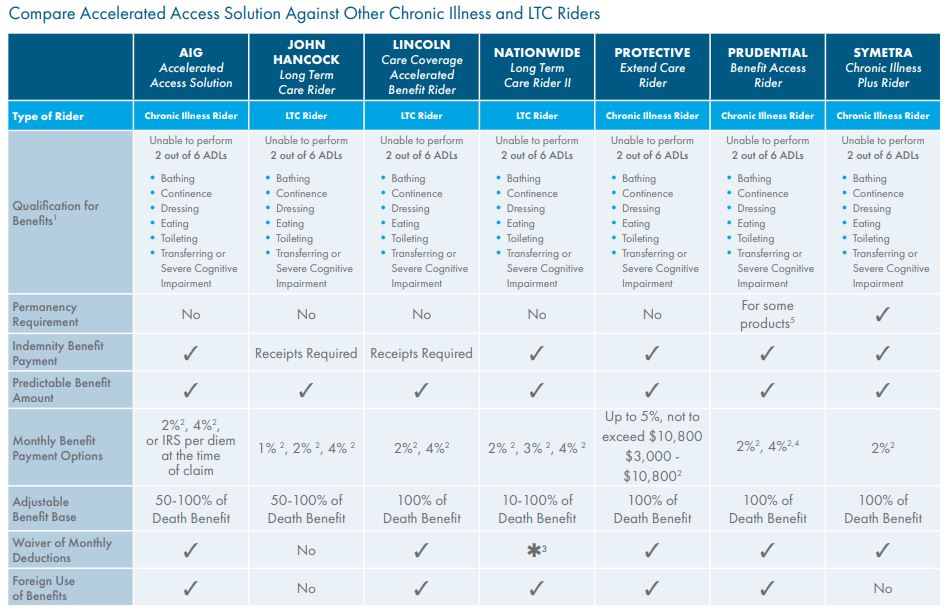
Comparisons of Term Life Products With Chronic Illness Riders

1/6/2020

0 Comments

 
Q. Which term life products have chronic illness rider included?


A. There is a new trend in term life product offerings - accelerated access solution that is innovative and flexible that allows policy owners to customize their chronic illness coverage and monthly payout according to their financial needs.  It helps with unexpected healthcare costs as well as other expenses due to chronic illness if it not a permanent condition.  Besides, it pays benefit on an indemnity basis - no receipts required and family care is covered!

Below is a comparison of some current offerings on the marketplace: 
Picture
If you are interested in any term life products with living benefits riders, please contact us.
0 Comments

What To Consider When Rollover a Lump Sum Pension Distribution

1/5/2020

0 Comments

 
​If you face a decision of whether to take a lump-sum distribution from your pension or not, and if yes, how, this Forbes article is a very good read, it addresses some of the key factors you should consider and the potential tax traps, for example, you have to do the rollover to a tax-advantaged account within 60 days since you receive the lump-sum payment; you won't owe taxes on the rollover to a traditional retirement account, but will face a tax bill for rolling the money to a Roth account; ...
0 Comments

3 Simple Steps to Prepare for Early Retirement - Step 3

1/4/2020

0 Comments

 
We discussed the second step to prepare for early retirement here, now the third step.

3. Create a Social Security strategy
You can't begin claiming Social Security benefits until at least age 62, so if you plan to retire earlier than that, you'll need to get by on other sources of income.  But it's also important to think about whether you want to claim Social Security at age 62 or wait longer to earn extra money each month.

Although you can start claiming benefits at 62, your checks will be reduced by up to 30% by doing so.  If you want to receive the full amount you're entitled to each month, you'll need to wait to claim until your full retirement age (FRA) -- which is either age 66, 67, or somewhere in between.  If you wait a little longer (up to age 70), you can receive extra money each month on top of your full amount -- up to 32% more if you have an FRA of age 66 and you wait until age 70 to claim.

There's no right answer for which age you should start claiming because it's a personal decision that depends on your unique situation.  If you need the money sooner rather than later, claiming at age 62 might be best.  If you expect to live a very long life and are worried you'll run out of savings, waiting to claim until age 70 could be beneficial to take advantage of those bigger checks for the rest of your life.

It's also important to know what benefits you're eligible for and to create a Social Security strategy with your spouse.  You may be entitled to receive other types of benefits besides the standard retirement monthly checks -- such as spousal benefits, survivors benefits, and divorce benefits -- and it's up to you to know what you're eligible for since the SSA typically won't notify you.

You may also want to strategize with your spouse to decide who should claim their benefits when.  For instance, the lower-earning spouse may choose to claim earlier to start earning extra income right away in retirement, while the higher-earning spouse might delay benefits to earn those bigger checks.  No matter when you choose to claim, make sure you've thought about your decision to ensure you're making the most of your benefits.

Retiring early isn't easy, but it can be one of the best decisions of your life.  Before you leave your job, though, make sure you've thought about major factors like how much you should save, how you'll cover healthcare costs, and when you'll claim Social Security benefits.  If you've done your homework and prepared the best you can, early retirement can be a dream come true.


0 Comments

3 Simple Steps to Prepare for Early Retirement - Step 2

1/3/2020

0 Comments

 
We discussed step 1 to prepare for early retirement here, now step 2.

2. Have a plan to cover healthcare costs
If you don't have a plan to cover healthcare costs, they could quickly drain your retirement fund.  You won't be eligible to enroll in Medicare until you turn 65, so if you retire before that, you'll need another form of health insurance.

One option is to enroll in COBRA coverage, which will allow you to stay on your former employer's insurance plan even after you leave your job.  However, COBRA insurance can be incredibly expensive and it doesn't last forever.

When you're enrolled in insurance as an employee, your employer covers the bulk of the annual costs.  The average annual premium for family health insurance coverage in 2019 is roughly $20,000, according to a recent report from the Kaiser Family Foundation.  Of that amount, employees only paid around $6,000 per year in premiums -- the rest was covered by the employer.

With COBRA insurance, though, your employer won't chip in to help pay for coverage.  You're also only able to stay on COBRA insurance for up to 18 months, so if you retire before age 63 1/2, you'll need to find another form of insurance before you can enroll in Medicare.

Another option is to buy insurance through the Affordable Care Act marketplace, although plans may be expensive.  You can find plans with lower premiums, but you'll typically face higher deductibles and out-of-pocket maximums.  If you have health issues and visit the doctor regularly, those costs can quickly add up.

Before you choose to retire early, make sure you've budgeted for health insurance.  One way to do that is to invest in a health savings account (HSA).  You have to be enrolled in a high-deductible healthcare plan to be eligible (meaning your deductible is at least $1,350 for individuals or $2,700 for families), but you can invest tax-deductible dollars, let your money grow over time, and then withdraw the money tax-free as long as it goes toward eligible medical expenses. 

The third step to prepare for early retirement is discussed here.


0 Comments

3 Simple Steps to Prepare for Early Retirement - Step 1

1/2/2020

0 Comments

 
Exactly what defines "early" retirement may differ for everyone.  However, regardless of the age at which you want to retire, here are 3 simple steps you can take to set yourself on the right path.

1. Know how much you'll be spending each year
This is the foundation of building a strong retirement strategy.  When you know what you're spending each year, you can better estimate how much money you'll need to save to last the rest of your life.  Then, with that number in mind, you can determine the amount you should be saving now to reach that goal by your desired retirement age.

Rather than taking a wild guess at how much you'll spend each year during retirement, really think about your future costs.  Do you plan to travel a lot in retirement?  Do you have a long list of home renovation projects you want to tackle?  Or do you plan to spend most of your time catching up on your reading and enjoying time with family?  Your costs in retirement could be similar to what you're spending now or vastly different.  But you won't know until you create a rough budget to estimate your future spending.

Once you have this number in mind, subtract the amount you expect to receive from other sources of income (Social Security benefits, a pension, etc.) to figure out how much of your retirement income will need to come from your savings.  Keep in mind, though, that you can't claim Social Security until you're at least age 62, so if you retire before that, you won't be able to depend on that income quite yet. 


Next, run your information through a retirement calculator to see how much you should aim to save by retirement age.  From there, your results will give you an estimate of your overall retirement savings goal, as well as what you'll need to save each month to achieve it.  Also, remember that if your employer offers matching 401(k) contributions, those should factor into your monthly saving goal too -- meaning you may not have to save as much on your own as you think.

In our next step, we will discuss the second step you need to take to prepare for an early retirement.


0 Comments

January 2020 PFwise.com Newsletter

1/1/2020

0 Comments

 
For archived newsletters, please visit here.
0 Comments
Forward>>

    Author

    PFwise's goal is to help ordinary people make wise personal finance decisions.

    Archives

    September 2022
    August 2022
    July 2022
    June 2022
    May 2022
    April 2022
    March 2022
    February 2022
    January 2022
    December 2021
    November 2021
    October 2021
    September 2021
    August 2021
    July 2021
    June 2021
    May 2021
    April 2021
    March 2021
    February 2021
    January 2021
    December 2020
    November 2020
    October 2020
    September 2020
    August 2020
    July 2020
    June 2020
    May 2020
    April 2020
    March 2020
    February 2020
    January 2020
    December 2019
    November 2019
    October 2019
    September 2019
    August 2019
    July 2019
    June 2019
    May 2019
    April 2019
    March 2019
    February 2019
    January 2019
    December 2018
    November 2018
    October 2018
    September 2018
    August 2018
    July 2018
    June 2018
    May 2018
    April 2018
    March 2018
    February 2018
    January 2018
    December 2017
    November 2017
    October 2017
    September 2017
    August 2017
    July 2017
    June 2017
    May 2017
    April 2017
    March 2017
    February 2017
    January 2017
    December 2016
    November 2016
    October 2016
    September 2016
    August 2016
    July 2016
    June 2016
    May 2016
    April 2016
    March 2016
    February 2016
    January 2016
    December 2015
    November 2015
    October 2015
    September 2015
    August 2015
    July 2015
    June 2015
    May 2015
    April 2015
    March 2015
    February 2015
    January 2015
    December 2014
    November 2014
    October 2014
    September 2014
    August 2014
    July 2014
    June 2014
    May 2014
    April 2014
    March 2014
    February 2014
    January 2014
    December 2013
    November 2013
    October 2013
    September 2013
    August 2013
    July 2013
    June 2013
    May 2013

    Categories

    All
    Annuity
    Book Reviews
    College Finance
    Finance In Formula
    Financial Scams
    For Entrepreneurs
    Healthcare
    Insurance
    Investment
    Miscellaneous
    Real Estate
    Retirement
    Savings
    Savings Ideas
    Stock-ideas
    Tax
    Tax-related

    RSS Feed

Powered by Create your own unique website with customizable templates.
